Critical Virtual Exchange in Artificial Intelligence
At Maseno University, the project involves staff from the Schools of Art & Social Science, School of Education, and School of Computing & Informatics who will deliver 5 virtual exchange modules covering different skills in AI to their students. The aim of the virtual exchange modules is to enhance the technical understanding of students in the application of AI and the critical thinking skills needed to carry out ethically sound work with AI, both during their studies and in their future life as informed and responsible professionals and citizens.
The kick-off meeting reviewed the project objectives, updated timeline, work plan, and roles across all work packages. Key clarifications were made on participant eligibility, partner responsibilities, and administrative requirements such as the signed Partnership Agreement and proof of prepayment.
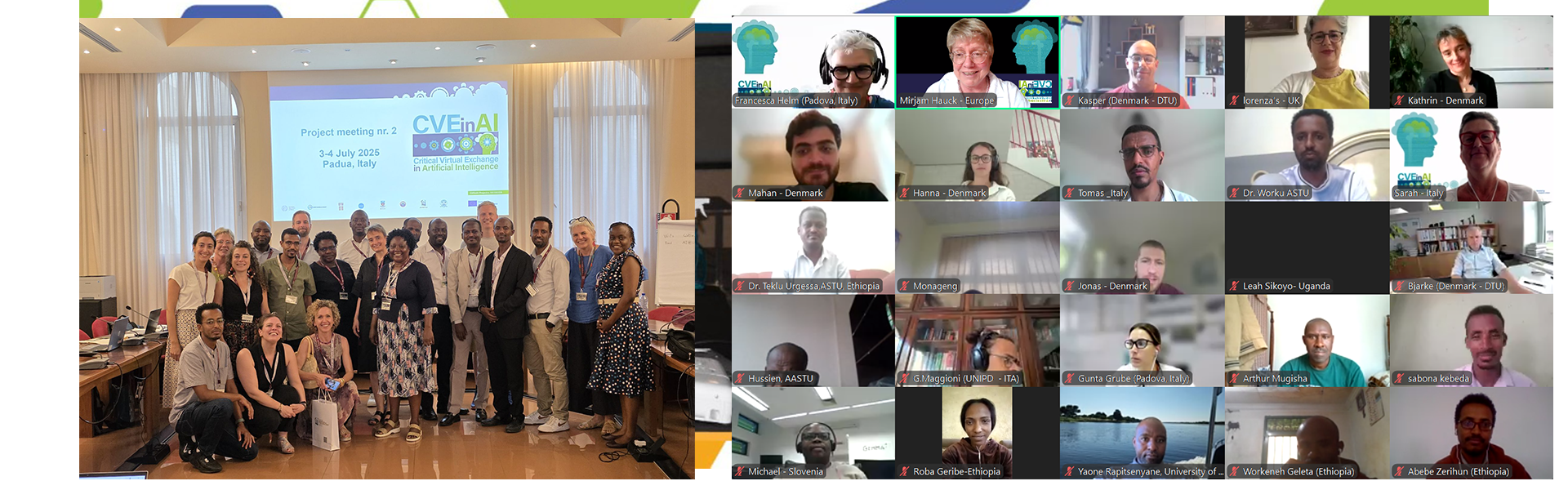
The face-to-face meeting in Padova reviewed project progress, clarified implementation priorities, and aligned partners on the next steps. Updates were shared on the work plan, partnership agreement, academic calendar mapping, and ongoing activities under WP2, WP4, and WP5. The Upskilling Masterclass was discussed in detail, highlighting progress in Tracks 1 and 2, participant challenges, and feedback on the “Critical” component of CVEinAI. Partners also began collaborative work on the design of the five modules, agreeing on common structures, learning objectives, resource requirements, and timelines. Discussions also explored how the CVEinAI course could fit into institutional programmes, recognition options, student recruitment targets, and strategies to promote participation.
This Professional Development course provides an introduction to virtual exchange and what distinguishes this approach to online education from other online courses (such as MOOCs).
The aim was to introduce university educators and staff from CVEinAI partner institutions to Virtual Exchange through experiential learning
Participants interacted with one another and their respective institutions, coming to a clear understanding on how to integrate virtual exchange into existing courses and curricula, and gain experience and insights into online collaboration, intercultural learning, teaching and learning and the development of materials and activities for a VE. Ten Students from Maseno University took part in the Master Class and were awarded certificates.
The project is committed to the development of five modules, based on titles provided in the original proposal. The modules follow a three-phase structure: Introduction, Comparison and Analysis, and Production and Collaboration, combining synchronous and asynchronous activities, including one facilitated two-hour online session per week.
The Modules Developed are:
· Module 1: AI Foundations, Uses and Critical Thinking
This unit introduces the foundations of AI and GenAI, their real-world applications, and develops critical thinking skills for evaluating AI outputs.
· Module 2: Ethical Issues and Bias Risks in Artificial Intelligence (AI)
Through the use of case studies, ethical frameworks, and interactive activities, this unit introduces learners to conceptual understanding and practical skills to recognize, analyze, and mitigate bias in AI, fostering responsible engagement with AI technologies.
· Module 3: AI Power, Trust, and Society: AI for Good vs AI for All
This unit explores the role of Artificial Intelligence (AI) in shaping societies by examining the ethical, political, and social implications of two influential frameworks: AI for Good and AI for All.
· Module 4: Responsible AI Design
This unit explores the pillars of responsible AI: transparency, accountability, security, and safety, including knowledge about data governance and AI regulations by the EU and African regions. It also looks into the environmental impact of AI.
Maseno University Team comprising post-graduate students and staff divided itself into 3 teams and supported the development of Module 1, 3 and 4 which was commendable. This task allowed the team to collaborate on online module development at an international level.